climbutah.com
Utah Rock Climbing
Field Guide
8 Routes · 4 Regions · Emergency Phrases · Hospital Directory · Trip Journal
Contents
- Routes3
- Indian Creek — Supercrack of the Desert3
- Zion — Moonlight Buttress4
- American Fork Canyon — Battle of the Bulge5
- Little Cottonwood Canyon — Beckey Route6
- Maple Canyon — Karate Crack7
- Castle Valley — Titan Tower (Finger of Fate)8
- Gear Checklist9
- Emergency Phrase Book10
- My Trip Journal11
- Insurance & Emergency Info12
- Hospital Directory13
- Local Guide Companies14

Indian Creek — Supercrack of the Desert
Moab · utah desert
Style
trad
Pitches
1
Approach
5 min from the road — park at the Supercrack pullout on UT-211
Climb time
1-3 hours depending on redpoint attempts
Total day
half day to full day
Elevation
+30m
Best season
March, April, May
Supercrack of the Desert is the most famous single-pitch trad route in America — a perfect 30-meter hand crack splitting a smooth orange sandstone tower in Indian Creek Canyon. The crack is relentlessly uniform, Wingate sandstone so clean it looks machined, and every single move is a hand jam. There is no variety, no rest, no relief: if your hand jams are not automatic and mechanical, this route will educate you in the most efficient possible way. The pro placements are trivially easy — four to six pieces of one size will protect the whole route — but your hands must be taped, your jams must be locked, and your footwork must be precise in the crack or you will barnyard off at move 20 out of 40. Supercrack gets sun in the morning and shade by early afternoon; in spring and fall it is climbable all day.
Crux
The entire route is the crux — 30 meters of sustained hand jams with no rest, the pump accumulates linearly from the first move to the last clip. The psychological crux arrives around two-thirds height where the pump peaks and your hands start to uncurl.
⚠ Warnings
- Never step on cryptobiotic soil crust — the biological soil crust surrounding routes takes 50-250 years to recover from a single footprint. Stay on rock or established trails at all times.
- Flash floods in Indian Creek Canyon can rise with no warning — check weather upstream (Monticello area) before committing to the canyon bottom.
- Summer temperatures exceed 100°F / 38°C on south-facing walls. June-August are for climbing at dawn only or not at all.
- The Supercrack pullout requires a $5 day-use fee or America the Beautiful annual pass — have it ready.
- Tape your hands before your first attempt. Wingate sandstone has a micro-texture that destroys untaped skin within one pitch. A taped jam is not optional comfort — it is essential equipment.
Gear Required
- 8-10 identical cams in the 0.9-1 inch range (Camalot #2 or equivalent)
- Tape gloves — do not skip this, raw hand jams on Wingate sandstone will shred skin in one day
- 60m rope
- helmet
- climbing shoes (stiff-soled for crack climbing)
- chalk bag
- 3L water — desert heat and sustained crack climbing dehydrate fast
Nearby Eats
- Moab Diner · American diner · $12-22
- The Broken Oar · Bar and grill · $15-28
- Peace Tree Juice Cafe · Cafe and smoothies · $8-16
My notes for this route
Zion — Moonlight Buttress
Springdale · zion
Style
multi-pitch
Pitches
9
Approach
45 min from the Angel's Landing trailhead (Zion shuttle required)
Climb time
12-18 hours for a fit team free climbing all pitches
Total day
full day — most teams start at 3-4AM with headlamps
Elevation
+610m
Best season
March, April, May
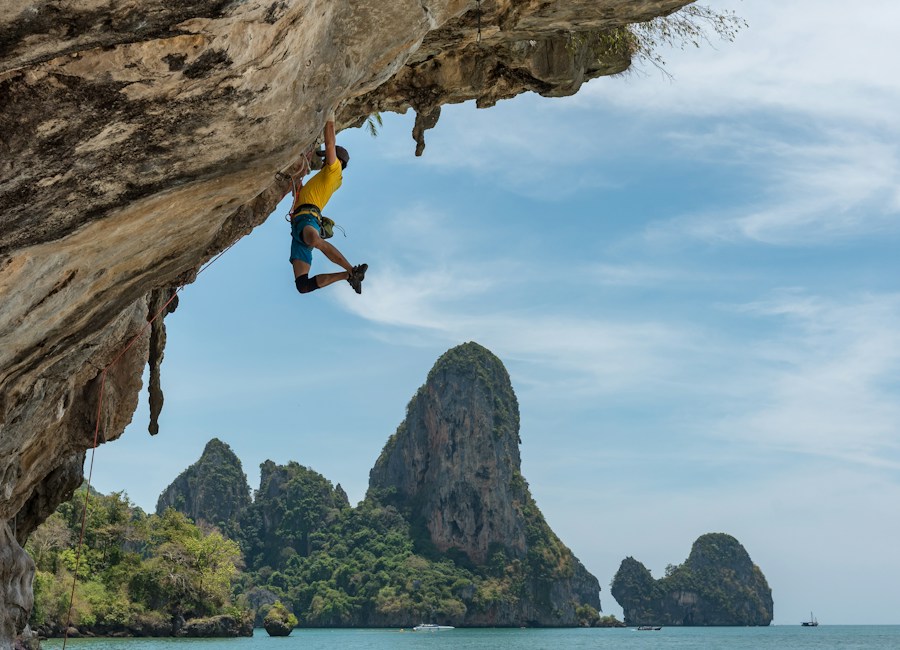
Moonlight Buttress is the most coveted big-wall free climb in Zion National Park — 9 pitches rising 610 meters on an impeccable Navajo sandstone prow above the Virgin River. The route was first climbed in 1971 by Jeff Lowe and Mike Weis and was considered an aid route for nearly three decades until Tommy Caldwell freed every pitch in 2000 at 5.12+. The stone is smooth, featured Navajo sandstone with crack systems, face holds, and a final headwall of sustained finger cracks that defines the route. The setting is extraordinary: the prow catches the last light in Zion Canyon and from the upper pitches you look directly down at the canyon floor, the Virgin River a silver thread below. A permit is required and competition for dates is significant — enter the lottery through Recreation.gov four days before your desired date.
Crux
Pitch 7 — the Prow: 5.12+ sustained finger locks and ring locks on a steep Navajo sandstone prow, 40 meters, technical face climbing between crack systems with exposure on all sides. The crux sequence involves a cross-step move at bolt 5 with feet on a 1-cm edge and both hands in shallow two-finger pockets.
⚠ Warnings
- A Zion National Park permit AND an Angels Landing Zone permit are BOTH required. Miss either and you will be turned back at the trailhead.
- Sandstone in Zion should never be climbed when wet or within 48 hours of rain. Wet Navajo sandstone is fragile and holds break — this is both a safety and an ethics issue.
- Flash floods in Zion Canyon are a serious and rapid-onset hazard. Check the Zion NPS flash flood forecast every morning. If there is any upstream precipitation, do not start.
- Summer temperatures in the canyon bottom regularly exceed 108°F / 42°C. Only experienced parties with exceptional heat management should attempt in July-August.
- This is a committing 5.12+ multi-pitch big wall. Do not attempt at your absolute technical limit — bail is difficult and the descent requires multiple rappels.
Gear Required
- 70m dry rope (the rappels on descent require 70m)
- Double rack: cams from 0.2 to 3 inches including doubles in 0.4-1 inch sizes
- 12 nuts assorted
- 10 quickdraws + 6 shoulder-length slings
- Helmet — mandatory, rockfall risk is real on a busy day in Zion
- Bivy gear if planning an overnight: sleeping bag rated to 5°C, insulation layer, gloves
- 4L water per person — water sources not available on route
- Headlamp — most teams start before sunrise
- Zion National Park entry permit AND Angels Landing Zone permit (both required for approach)
Nearby Eats
- Oscar's Cafe · Mexican restaurant · $14-26
- Spotted Dog Cafe · American fare · $18-34
- Whiptail Grill · Tacos and burritos · $10-18
My notes for this route
American Fork Canyon — Battle of the Bulge
American Fork · wasatch
Style
sport
Pitches
1
Approach
20 min from the American Fork Canyon entrance booth up UT-92, then 5-min walk to the main cave sector
Climb time
2-5 hours depending on redpoint attempts
Total day
half day to full day
Elevation
+40m
Best season
April, May, June
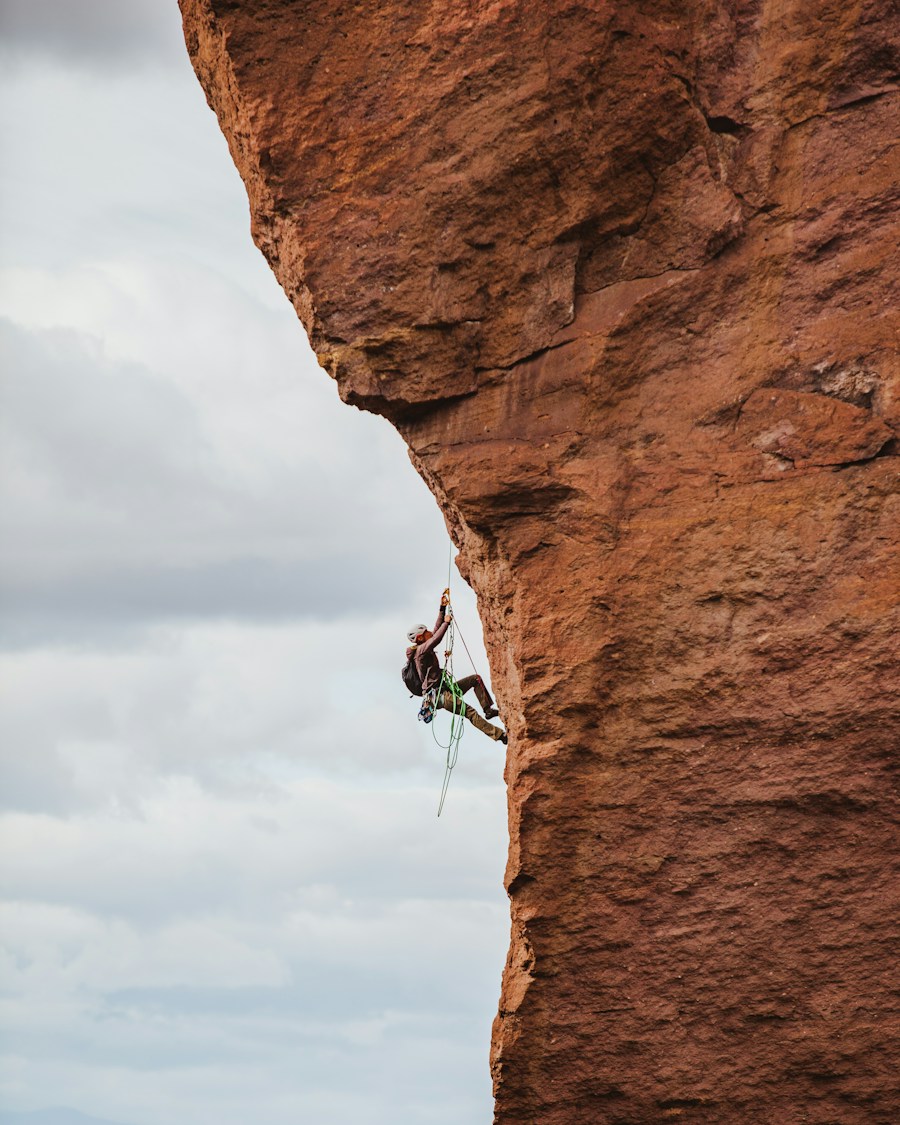
Battle of the Bulge is the benchmark route of American Fork Canyon — the limestone sport climbing destination that Utah locals consider the best in the American Mountain West. The route climbs 25 meters of overhanging Mississippian limestone in the main cave sector, a pocket-and-rail sequence on slightly overhanging gray stone with outstanding bolt protection every 1.5-2 meters. American Fork Canyon's limestone is geologically distinct from the desert sandstone elsewhere in Utah — the holds are sharp, featured, and grippy, and the cave sector maintains comfortable temperatures year-round: cool shade in summer, protected from wind and precipitation in shoulder season. The 5.12a grade falls on a prominent kink in the grade distribution at AFC — there are many 5.11 routes nearby, making it an ideal gym-to-outdoor step-up for climbers building toward their first outdoor 5.12.
Crux
The crux arrives at two-thirds height on the overhanging wall — a four-move sequence linking a three-finger pocket to a right-hand rail with a cross-step and a long reach to the next pocket. The sequence requires commitment: the cross-step is uncomfortable until you understand the hip position, and the long reach clips poorly unless your left foot is precisely placed on the small limestone edge below.
⚠ Warnings
- American Fork Canyon parking fills quickly on weekends — arrive before 9AM or the lower lots will be full and you will be parked 0.5 miles from the sector.
- The $6 day pass is collected at the entrance booth and is cash or credit. No pass = no entry. There is no way around the booth.
- Limestone holds at AFC are sharp-edged and will shred finger skin faster than sandstone routes of similar grade. Tape finger tips if you have tender skin.
- The cave sector is cold — bring a belay jacket even in July. Climbers get hypothermic waiting for redpoint attempts in the shade.
- No cell service in the upper canyon. Download your topo on Mountain Project before leaving Provo.
Gear Required
- 70m rope (recommended — some climbers use a 60m but 70m is more comfortable for the lower)
- 14-16 quickdraws
- Helmet
- Limestone climbing shoes — a softer, more sensitive shoe outperforms crack shoes on AFC pockets
- Chalk bag with a full block of chalk — limestone eats chalk faster than sandstone
- Warm mid-layer — the cave sector is shaded year-round and cool even in July
- 2L water
- $6 day pass (collected at the canyon entrance booth)
Nearby Eats
- Communal Restaurant · Farm-to-table American, Provo · $18-38
- Cubby's Chicago Beef · Italian beef and hot dogs, Provo · $9-15
My notes for this route
Little Cottonwood Canyon — Beckey Route
Salt Lake City · wasatch
Style
trad
Pitches
3
Approach
30 min drive from Salt Lake City on UT-210, then 15-min approach walk from the Gate Buttress parking area
Climb time
3-5 hours
Total day
half day
Elevation
+120m
Best season
May, June, July
The Beckey Route on Gate Buttress in Little Cottonwood Canyon is the canonical introductory trad climb in the Wasatch Range — a three-pitch line on granite that climbers have used for decades to introduce partners to crack climbing, natural protection, and multi-pitch movement. Fred Beckey put up hundreds of first ascents across North America and this route carries his name accurately: accessible, well-protected, memorable, and positioned on stone that will teach you something. The granite in Little Cottonwood is a high-quality quartz monzonite — coarse-grained, good friction, and dramatically different from the desert sandstone that defines the rest of Utah climbing. The canyon itself is spectacular: a narrow glacially carved U-shaped valley with walls rising 2,000 feet, and on a clear Wasatch morning the light on Gate Buttress is exceptional. The canyon road can close for avalanche control November-April; always check UDoT conditions before driving up.
Crux
Pitch 2 — the central crack system: 5.8 finger-to-hand crack on solid Wasatch granite, 25 meters, the crux is a transition from finger crack width (Camalot #0.75) to a hand crack (Camalot #2) where the crack flares slightly and the hand jam feels unreliable until you find the correct rotation angle for the rock.
⚠ Warnings
- The LCC road (UT-210) closes for avalanche control November-April — check UDoT road conditions at udottraffic.utah.gov before driving up. Closures happen with no advance notice.
- Little Cottonwood is a watershed protection zone. No dogs allowed in the canyon — this is strictly enforced by rangers.
- The canyon sees heavy traffic: hikers, climbers, and cyclists all share the road. Park only in designated climbing pullouts — illegal parking results in towing.
- Afternoon thunderstorms are common July-August. Descend before 1PM on summer afternoons when cumulus clouds develop over the Wasatch crest.
Gear Required
- Single rack: cams 0.5-3 inch (Camalots #1, #2, #3 are the money sizes)
- 4 nuts (#4-8 Black Diamond)
- 60m rope
- Helmet
- Rock shoes with moderate stiffness — granite rewards a stiffer sole than gym slippers
- 2L water
- Wind layer — the canyon funnels strong gusts even on warm days
Nearby Eats
- Laziz Kitchen · Lebanese street food, Salt Lake City · $10-18
- Squatters Pub Brewery · Craft beer and pub food, SLC · $14-26
My notes for this route
Maple Canyon — Karate Crack
American Fork · wasatch
Style
sport
Pitches
1
Approach
2 hours from American Fork or Salt Lake City south on US-89 to Ephraim, then 10 min into Maple Canyon on a dirt road
Climb time
1-2 hours
Total day
half day as part of a multi-route day in the canyon
Elevation
+25m
Best season
May, June, September
Maple Canyon is Utah's cobblestone climbing — an entirely different rock type from the sandstone towers of Moab and the limestone caves of American Fork. The canyon walls are composed of conglomerate: river cobbles and boulders cemented in a gray matrix, creating a wildly textured surface where the holds are rounded stones ranging from marble-sized to softball-sized, protruding from the wall like a climbing wall designed by geology. Karate Crack is the canyon's most photographed line — a 20-meter sport route where a vertical crack system splits a conglomerate wall, the cobbles forming both the crack edges and the face holds on either side. The movement is unlike any other climbing in Utah: you pull on rounded stones that feel insecure until you weight them fully, and the conglomerate texture locks rubber soles in a way that Wasatch granite does not. The canyon is 2 hours south of American Fork, making it a dedicated day trip — bring enough routes to justify the drive.
Crux
The crux is 15 meters up on the main crack system — a three-move sequence on a sequence of rounded cobbles where the left-hand hold is a protruding marble-sized stone and the right-hand side-pull is a larger cobble at an awkward angle. The sequence rewards body tension and contact strength over crimp strength: you must trust rounded holds that feel wrong before you fully weight them.
⚠ Warnings
- Conglomerate holds at Maple Canyon pull off without warning — this is the most important safety note in the canyon. Test every hold by tapping and wiggling before weighting. Helmet is non-negotiable.
- The canyon road is dirt and becomes impassable when wet. Check weather 48 hours in advance — if there is any chance of rain, delay your visit.
- Maple Canyon is a 2-hour drive from most Utah bases. Make sure you have enough routes planned to justify the round trip — the canyon has 400+ routes but arrive with a list.
- Flash floods in narrow canyon environments are a real hazard. Do not enter the lower canyon if storms are developing upstream.
Gear Required
- 60m rope
- 12-14 quickdraws
- Helmet — conglomerate holds pop off without warning; wear a helmet without exception
- Climbing shoes with soft rubber (La Sportiva Solution or equivalent) — cobble holds require maximum rubber contact
- Chalk bag
- 2L water
Nearby Eats
- Centerfield Farms Market · Fruit stand and local produce, Ephraim · $5-15
- Communal Restaurant · Farm-to-table, Provo (on return drive) · $18-38
My notes for this route
Castle Valley — Titan Tower (Finger of Fate)
Moab · canyonlands
Style
trad
Pitches
5
Approach
45 min drive from Moab + 45 min approach hike from the Castle Valley Road pullout
Climb time
6-8 hours car to car
Total day
full day
Elevation
+290m
Best season
March, April, October
The Titan is the tallest freestanding sandstone tower in North America — 900 feet of Cutler sandstone rising from the Castle Valley floor outside Moab, a geological improbability that has been drawing climbers since Layton Kor made the first ascent in 1962. The Finger of Fate route takes five pitches to the summit via the south face and east ridge, climbing Cutler sandstone that is simultaneously friable and featured — the holds feel improbable until the moment you weight them. The summit of the Titan is one of the transcendent experiences in American climbing: standing on a platform slightly larger than a car roof, 900 feet of air on all sides, with the Castle Valley rincon below and the La Sal Mountains filling the eastern horizon. This is not a technical route by absolute standards but it demands judgment, experience with soft rock, and the psychological composure to lead above gear on sandstone towers with serious air below you.
Crux
Pitch 3 — the East Ridge: 5.9 exposed ridge traverse on Cutler sandstone, 30 meters, the technical crux is a step-across move from the ridge knife-edge to a face feature above where the sandstone is notably softer than the lower pitches. Place a cam in the crack before the step — the consequence of a fall here is a severe pendulum.
⚠ Warnings
- Cutler sandstone on the Titan sheds rock continuously — helmet is non-negotiable, and you must communicate rockfall warnings clearly to your partner at all times.
- The route is committing once you pass pitch 3 — descent requires multiple rappels and retreat from the upper pitches is slow and involved. Do not start after 9AM.
- The Castle Valley road floods in heavy rain and becomes impassable — check conditions the night before.
- Desert tower fatigue: the psychological intensity of sustained exposure on a sandstone tower depletes energy faster than a similarly graded wall route. Eat and drink aggressively throughout the climb.
- Do not climb Cutler sandstone within 48 hours of rain. It takes longer to dry fully than Wingate or Navajo and soft rock is a falling-hold hazard.
Gear Required
- Double rack: cams from 0.5 to 3.5 inches — the Titan has wide crack sections
- 6 nuts
- 60m rope
- 6 shoulder-length slings (the ridge traverse requires long runners to reduce rope drag)
- Helmet — mandatory on sandstone towers, rockfall is frequent and the tower sheds rock continuously
- Rappel device + autoblock backup
- 3L water per person — full day in the desert
- Approach shoes for the hike-in plus rock shoes for climbing
Nearby Eats
- Desert Bistro · Upscale American · $28-55
- Moab Brewery · Brewpub · $14-26
- Jail House Cafe · Breakfast · $10-18
My notes for this route
Gear Checklist
Print and pack. Check off each item before leaving for the crag.
Standard Sport Rack
60m dry-treated rope
Most Utah sport pitches run 25-40m. Dry treatment handles morning canyon condensation in American Fork and Zion. For Moonlight Buttress, upgrade to 70m — the descent rappels require it.
12-14 quickdraws
American Fork cave routes run 10-14 bolts on full-length pitches. Maple Canyon conglomerate routes are typically 8-12 bolts. Bring more than you think you need.
Belay device (GriGri preferred for single-pitch projecting)
A GriGri allows the belayer to give soft catches repeatedly without muscle fatigue on a projecting day. An ATC works fine for multipitch. Both have a place in Utah climbing.
Climbing shoes — medium stiffness for limestone
American Fork limestone rewards a shoe with enough structure to edge on small pockets but enough sensitivity to feel tufa features. Avoid ultra-stiff crack shoes for sport climbing. La Sportiva Solution or Scarpa Instinct are good benchmarks.
Chalk bag and loose chalk
Limestone is polished by traffic and chalk retention is important. Use loose chalk generously on sport routes. On trad crack climbing, reduce chalk use — excessive chalk on sandstone damages the rock surface.
Helmet
Mandatory on all Utah trad and multi-pitch routes. Recommended on all sport routes. Rockfall risk is real in desert canyons — loose Entrada and Wingate sandstone sheds regularly, especially after rain and freeze-thaw cycles.
Harness
A well-padded waist belt matters on long sport projecting days. Thin alpine harnesses are uncomfortable after 4+ hours of hanging and resting on routes.
Locking carabiners (3 minimum)
For anchor building, belay device attachment, and rappel setups. Bring at least three — one for your belay device, one for the anchor masterpoint, one for your partner.
Minimum Safety Kit
HelmetCRITICAL
Desert sandstone sheds rock at a higher rate than granite. A helmet is non-negotiable on all Utah desert and canyon routes.
Personal anchor system (PAS or sling with locking biner)CRITICAL
For clipping into anchors at multi-pitch belay ledges. A 120cm sling with a locker is the minimum; a dedicated PAS gives more adjustment range.
Prussik cords (two x 5-6mm x 60cm)CRITICAL
For self-rescue, ascending a fixed line, and rappel backup on multi-pitch descents. Moonlight Buttress has 11 rappels — a prussik backup on every rappel is essential practice.
Headlamp with fresh batteriesCRITICAL
Multi-pitch routes in Utah often extend past dark — especially Moonlight Buttress and Castleton Tower on slower days. A headlamp in your pack costs nothing and may save your life.
First aid kit (compact climbing-specific)
Minimum: blister treatment, wound closure strips, ace bandage, ibuprofen. At Indian Creek add extra hand tape and skin cream for abrasion treatment.
Emergency bivy (SOL Escape Pro or equivalent)
For big multi-pitch routes (Moonlight Buttress, Castleton Tower) where an unexpected bivy is possible. A lightweight emergency bivy weighs 150g and fits in a jacket pocket.
Sun protection: SPF 50 sunscreen, sun hat, long sleeves
Desert climbing at Indian Creek and Castleton Tower involves full sun exposure with no shade. UV radiation at 1500m+ is severe. Sunburn on a 3-day Creek trip can end the trip early.
Water: 3L minimum per person per dayCRITICAL
There is no water at Indian Creek, at the base of Castleton Tower, or on the approach to any desert route. Carry full water from your car. In summer and early fall, 3L per person per day is the minimum — 4L is safer.
Emergency Phrase Book
Learn these before you go. You will not have time to look them up above pitch 3.
| Phrase | Phonetic | English |
|---|---|---|
| Help! | HELP | Help! |
| I need help | eye need HELP | I need help |
| Call Search and Rescue | call SEARCH and RES-cue | Call Search and Rescue |
| My partner fell | my PART-ner fell | My partner fell |
| Where is the hospital? | where is the HOS-pi-tal | Where is the hospital? |
| I am injured | eye am IN-jured | I am injured |
| Call 911 | call NINE-one-one | Call 911 (US Emergency) |
| We need a helicopter | we need a HEL-i-cop-ter | We need a helicopter evacuation |
| ¡Ayuda! (Spanish) | ah-YOO-da | Help! (Spanish — for Moab area) |
| Necesito ayuda (Spanish) | neh-seh-SEE-toh ah-YOO-da | I need help (Spanish) |
| Llame al rescate (Spanish) | YAH-meh al res-KAH-teh | Call rescue (Spanish) |
| ¿Dónde está el hospital? (Spanish) | DON-deh es-TAH el os-pee-TAL | Where is the hospital? (Spanish) |
Emergency Numbers — Utah
911
911 (All Emergencies)
435-259-8115
Search & Rescue (Grand Co.)
435-772-0170
NPS Emergency (Zion)
*11
Utah Highway Patrol
My Trip Journal
Day 1
Day 2
Day 3
Day 4
Insurance & Emergency Info
Fill this in before leaving home. Keep a photo on your phone as backup.
Insurance provider
Policy number
24h emergency line
Coverage includes climbing
Medical evacuation covered
Home country emergency contact
Contact phone number
Local hotel address
Hotel phone number
Blood type
Allergies
Medications
Hospital Directory
Nearest emergency facilities to each climbing area.
Moab / Indian Creek / Canyonlands
Moab Regional Hospital
450 W Williams Way, Moab, UT 84532
24h emergency. Trauma capable. For major trauma: University of Utah Medical Center, SLC (5h drive or Life Flight).
Zion National Park
Dixie Regional Medical Center (St. George)
1380 E Medical Center Dr, St. George, UT 84790
Level II Trauma Center. 24h. Nearest full emergency to Springdale.
American Fork Canyon / Wasatch
Utah Valley Hospital (Intermountain)
1034 N 500 W, Provo, UT 84604
Level II Trauma Center. 24h emergency. Closest to American Fork and Little Cottonwood.
Salt Lake City / Little Cottonwood
University of Utah Medical Center
50 N Medical Dr, Salt Lake City, UT 84132
Level I Trauma Center — Utah's highest trauma designation. Life Flight landing pad.
Local Guide Companies
Vetted operators. All guides are AMGA-certified or equivalent. Confirm current availability and pricing directly.
Moab Desert Adventures
Moab
moabdesertadventures.com · +1 435-260-2404
AMGA-certified guides. Indian Creek, Canyonlands. Crack clinics available.
Desert Highlights
Moab
deserthighlights.com · +1 435-259-4433
Small groups, custom desert routes. Indian Creek specialists.
Exum Mountain Guides
Salt Lake City
exumguides.com · +1 307-733-2297
AMGA-certified. Wasatch, Little Cottonwood. Multi-pitch and trad instruction.
Waterfall Canyon Outfitters
American Fork
waterfallcanyonoutfitters.com · +1 801-726-0288
American Fork Canyon limestone specialists. Sport + trad.
Zion Adventure Company
Springdale (Zion)
zionadventures.com · +1 435-772-1001
Zion National Park specialists. Moonlight Buttress permit assistance.
climbutah.com
The definitive English-language guide to sport climbing in Utah.
This guide is for informational purposes only. Climbing is inherently dangerous. Always climb with a qualified partner. Verify all beta locally before committing to a route. Affiliate disclosure: climbutah.com/affiliate-disclosure